
Texas District Court Jurisdiction
District courts are the trial courts of general jurisdiction in Texas. The Texas Judicial Branch says they hear felony criminal cases, divorce, disputes over land title, election contests, and civil cases where the amount in question is $200 or more. They also take any matter not placed in another court. That broad reach makes the district court the heart of the trial system.
The screenshot below shows the Texas Judicial Branch trial-courts page.
The Texas Judicial Branch trial-courts page describes district, county, justice, and municipal court jurisdiction.
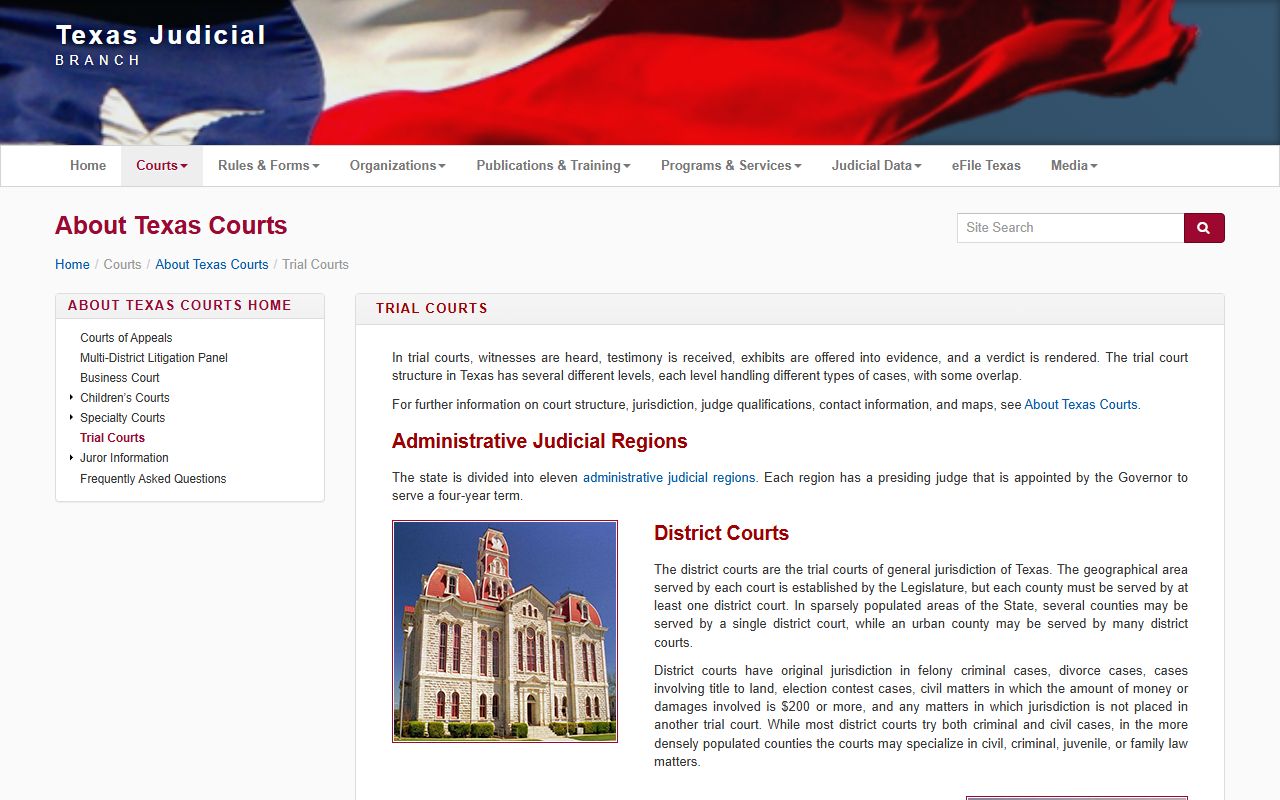
In Brazoria County, the District Clerk is the custodian for these district court files. Felony, civil, and family records are searched through the county portal and copied through the District Clerk.
Texas runs one of the more complex trial systems in the country. The state uses seven kinds of trial court, from district courts down to municipal courts, plus a Business Court added in recent years. Brazoria County uses most of these levels. The district court sits at the top of the local trial structure, with the county courts at law, justice courts, and municipal courts handling lighter matters below it.
Brazoria County District Courts
Brazoria County has five district courts, each with an elected judge and a court coordinator. All sit at the Brazoria County Courthouse campus in Angleton. The table below lists the courts, the judges, and a contact number for each.
| Court | Judge | Location | Phone |
|---|---|---|---|
| 149th District Court | Jessica Pulcher | Angleton | 979-864-1261 |
| 239th District Court | Greg Hill | Angleton | 979-864-1256 |
| 300th District Court | Chad Bradshaw | Angleton | 979-864-1227 |
| 412th District Court | Justin R. Gilbert | Angleton | 979-864-1915 |
| 461st District Court | Patrick Bulanek | Angleton | 979-864-1205 |
The 300th District Court handles family-court resources, and the 461st posts guidelines for self-represented litigants. Each court has its own coordinator who manages settings and answers scheduling questions. To find a setting in any of these courts, use the court dockets search, which also lists the coordinator contacts.
County Courts at Law and Probate Courts
Below the district courts sit four county courts at law, each also serving as a Probate Court. These statutory courts handle misdemeanors, county-level civil cases, probate, and guardianship. The same judges who hear county cases also hear wills and estates.
| Court | Judge |
|---|---|
| County Court at Law No. 1 and Probate Court | Courtney T. Gilbert |
| County Court at Law No. 2 and Probate Court | Thomas Pfeiffer |
| County Court at Law No. 3 and Probate Court | Jeremy E. Warren |
| County Court at Law No. 4 and Probate Court | Lori Rickert |
County court files run through the County Clerk, not the District Clerk, which is a key difference for anyone ordering a copy. The probate records page covers the probate side of these courts, and the County Clerk page covers their records.
Where the Brazoria County Courts Sit
The district courts and county courts at law share the government campus on Locust Street in downtown Angleton, the county seat. The county lists the traditional courthouse address as 111 E. Locust St., while several record offices now work from the Administration Building at 237 E. Locust. The courthouse itself is a five-story Moderne-style building finished in 1940.
One change affects every visit. County Court at Law No. 4 states that, as of January 1, 2025, the only courthouse entry is at 237 E. Locust, the new Administration Building. So even though older pages list 111 E. Locust, plan to enter through 237 E. Locust and allow time for security. Confirm the exact court and room before you arrive, since a hearing and a record counter may sit in different parts of the campus.
District Court vs County Court vs Justice Court
Texas trial courts divide work by the seriousness of the case. The district court takes the heaviest matters, the county court takes mid-level ones, and the justice court takes the smallest. This table sets the three levels side by side.
| Point | District Court | County Court at Law | Justice Court |
|---|---|---|---|
| Criminal | Felony | Misdemeanor | Class C, fine-only |
| Civil reach | $200 and up | County-level civil | Small claims |
| Family and probate | Divorce and family | Probate and guardianship | None |
| Custodian | District Clerk | County Clerk | JP court |
Municipal courts add a fourth level for city ordinance and Class C cases inside city limits. The traffic court records page covers the JP and municipal courts that handle most citations.
How a Case Moves Through the System
A case enters the Texas court system at the level that matches its seriousness, and it can move up on appeal. Most cases stay in one court from filing to judgment. The flow below shows the typical path.
Case path: Justice or Municipal Court › County Court at Law › District Court › Court of Appeals › Supreme Court of Texas or Court of Criminal Appeals
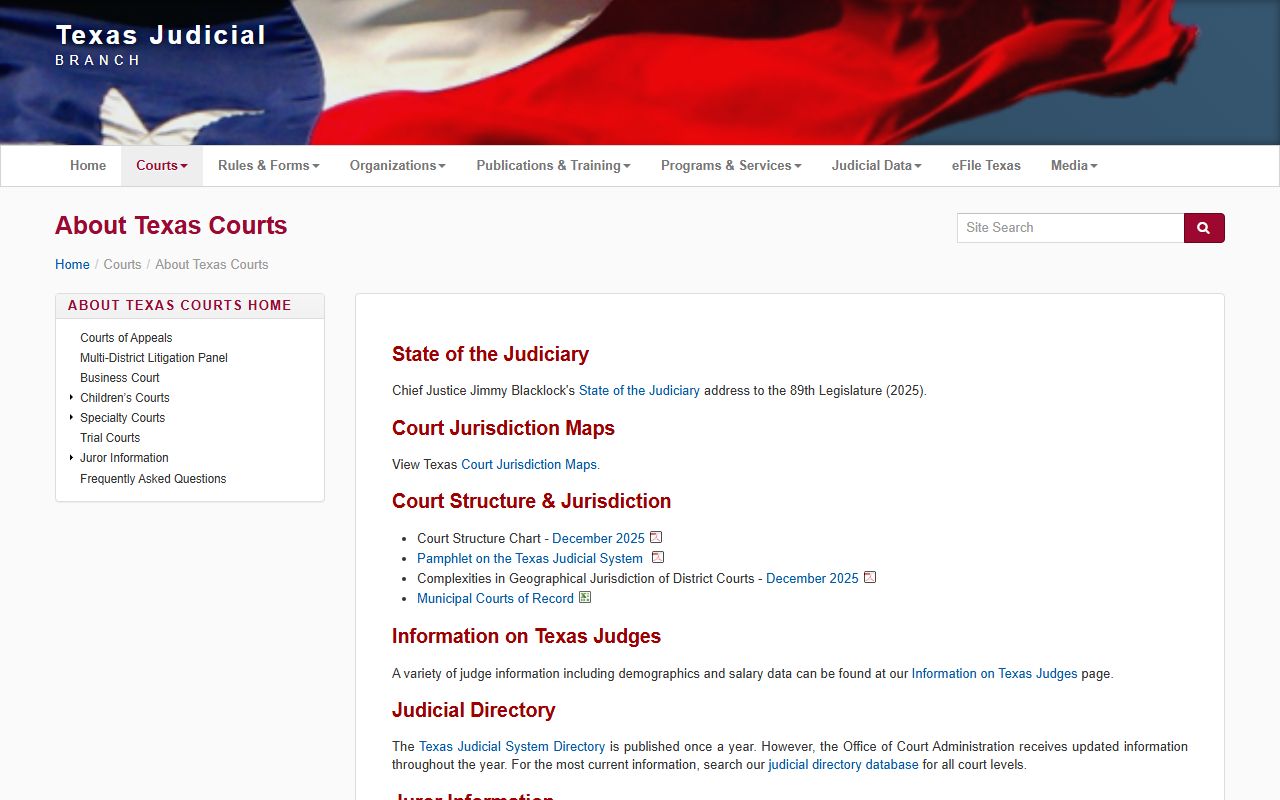
The screenshot below shows the Texas Judicial Branch overview of the state's courts.
The Texas Judicial Branch courts overview explains how the levels connect.
Appeals from a justice or municipal court usually go to a county-level court for a new trial or review. A district court judgment is appealed to a Texas Court of Appeals, as the next section explains.
Civil, Family, and Criminal Assignment
How a case is assigned depends on its type. The District Clerk's civil department randomly assigns civil suits among the 149th, 239th, and 412th District Courts, so a civil case can land in any of the three. Family matters such as divorce also run through the district courts, and the 300th handles family-court resources.
Criminal felony cases are filed through the District Clerk's criminal department, which keeps causes current, issues warrants and directives to the jail, and prepares penitentiary packets after a conviction. The arrest records and court records pages explain how to follow a criminal case from booking through disposition.
Justice and Municipal Courts
Below the county courts, Brazoria County has eight justice of the peace places across four precincts. Justice courts handle lower civil disputes, eviction, small claims, and Class C matters, including many traffic citations. Two of them, JP4-1 and JP2-1, appear as their own locations in the county court portal.
Municipal courts are city courts. They handle city ordinance violations and Class C misdemeanors inside a city's limits, in places like Pearland, Alvin, Lake Jackson, and Angleton. A ticket written inside a city often goes to that city's municipal court rather than a county JP court, so the court named on the paperwork is the one that controls.
These lower courts carry a heavy share of the county's case volume, even though each case is small. They also serve as a first stop for many residents who never see a district court. An appeal from a justice or municipal court is heard at the county level, often as a brand-new trial, which keeps these courts tied into the larger system.
Appeals from Brazoria County
A district court is not the last word. Appeals from Brazoria County generally go to a Houston-based Court of Appeals, the First or the Fourteenth, depending on assignment. Those intermediate courts review the trial court's work for legal error.
Above them sit two high courts. The Supreme Court of Texas is the final court for civil and family cases. The Texas Court of Criminal Appeals is the final court for criminal cases. So a civil appeal and a criminal appeal split paths at the top of the system, even though both start in the same Brazoria County district court.
An appeal is not a new trial. The appeals court reviews the record from the trial court for legal error rather than hearing the case again. That is why the trial-court file the District Clerk keeps matters so much. The record made in the Brazoria County district court is what the higher courts read.
Specialty Courts in Brazoria County
The district courts also run problem-solving programs that work alongside the regular dockets. County navigation lists a Domestic Violence Court Program, a S.T.E.P. Program that serves as the county drug court, and a Veterans Court, each with a participant handbook.
These programs trade close supervision for a chance at treatment and a better result. A drug court sets phases, regular drug testing, and frequent court reviews. A veterans court adds mentoring and a link to VA services and benefits. A case in one of these programs still appears in the normal court record, which the court records page explains how to search.