
How to Search for Brazoria County Warrants
No official Brazoria County page lists active warrants in one searchable place. That does not mean a warrant cannot be found. Clues live in two systems on the Tyler PublicAccess portal. The Criminal Records search can show capias and bond-forfeiture entries in a case docket. The Jail Records search shows a warrant number tied to a booking. Reading both gives the clearest public view.
Start with a name or a case number. The case-number asterisk rule still applies. A court record may show a capias was issued after a missed date, and a jail record may show the warrant number that led to a booking. Neither is a promise that a warrant is still open, since a warrant can be served, recalled, or quashed.
- Open the portal and search Criminal Records by defendant name.
- Open the case and read the docket for capias or forfeiture entries.
- Switch to Jail Records and search the same name.
- Check any booking for a warrant number and charge.
- Call the issuing court or clerk to confirm current status.
Avoid third-party warrant lists. They are not official, may be wrong, and are not used on this site. The court and the Sheriff hold the real status.
Where Warrants Appear in Brazoria County Records
Warrants touch several official workflows. The District Clerk Criminal Department says its clerks issue warrants and directives to the jail in district criminal cases. A sample criminal case in the portal showed a capias alias and a judgment nisi after a bond or court problem. A sample jail booking carried a warrant number field. And jail results often list charges such as capias pro fine, failure to appear, bond forfeiture, motion to revoke, and various holds.
So a person checking for warrants is really reading the edges of the court and jail systems. A capias in a docket points to a court action. A warrant number in a booking points to the order that brought someone in. The county's expunction agency list, which names the Sheriff, the clerks, the District Attorney, the bond board, and the JP courts, also shows how many offices can hold warrant-related records for a single case.
Brazoria County Jail Warrant Record Fields
When a warrant leads to a booking, the jail record breaks it into clear fields. The charge table in a booking detail is the closest thing to a public warrant record in the county system. These are the fields it uses.
| Field | Meaning |
|---|---|
| Warrant # | The warrant, case, or cause reference for the charge |
| Charge | The warrant charge or arrest charge |
| Issuing Auth | The authority that issued the warrant |
| Offense Date | The date of the underlying offense |
| Bond / Type | The bond amount and type, if set |
| Fine / Crt Costs | Any fine or court costs shown |
| Disposition | The release or docket outcome |
To pull these fields, use the Brazoria County inmate records search and open a booking. Some fields, like issuing authority, can be blank in a given record.
Types of Warrants in Brazoria County
Not all warrants are the same. The word covers several court orders, each with its own trigger. Reading the right term helps you understand why a warrant exists and how to clear it.
- Arrest warrant: issued on probable cause to arrest a person.
- Bench warrant or capias: issued by a court for a missed appearance or a failure to comply.
- Capias pro fine: used in fine-only cases when a person does not pay or appear.
- Search warrant: authorizes a search or seizure and may be sealed during an investigation.
- Fugitive warrant or hold: based on out-of-county or out-of-state authority.
- Bond forfeiture or judgment nisi: triggered when a defendant fails to appear after posting bond.
- Motion to revoke or adjudicate: filed for a probation or deferred-adjudication violation.
The court records page explains how these entries read inside a case docket.
How to Resolve an Outstanding Brazoria County Warrant
An open warrant does not go away on its own. The safe path is to confirm it, then act through the right court. Active investigative details can be withheld even when basic case facts are public, which is one reason a phone call to the issuing court beats guessing from an online entry.
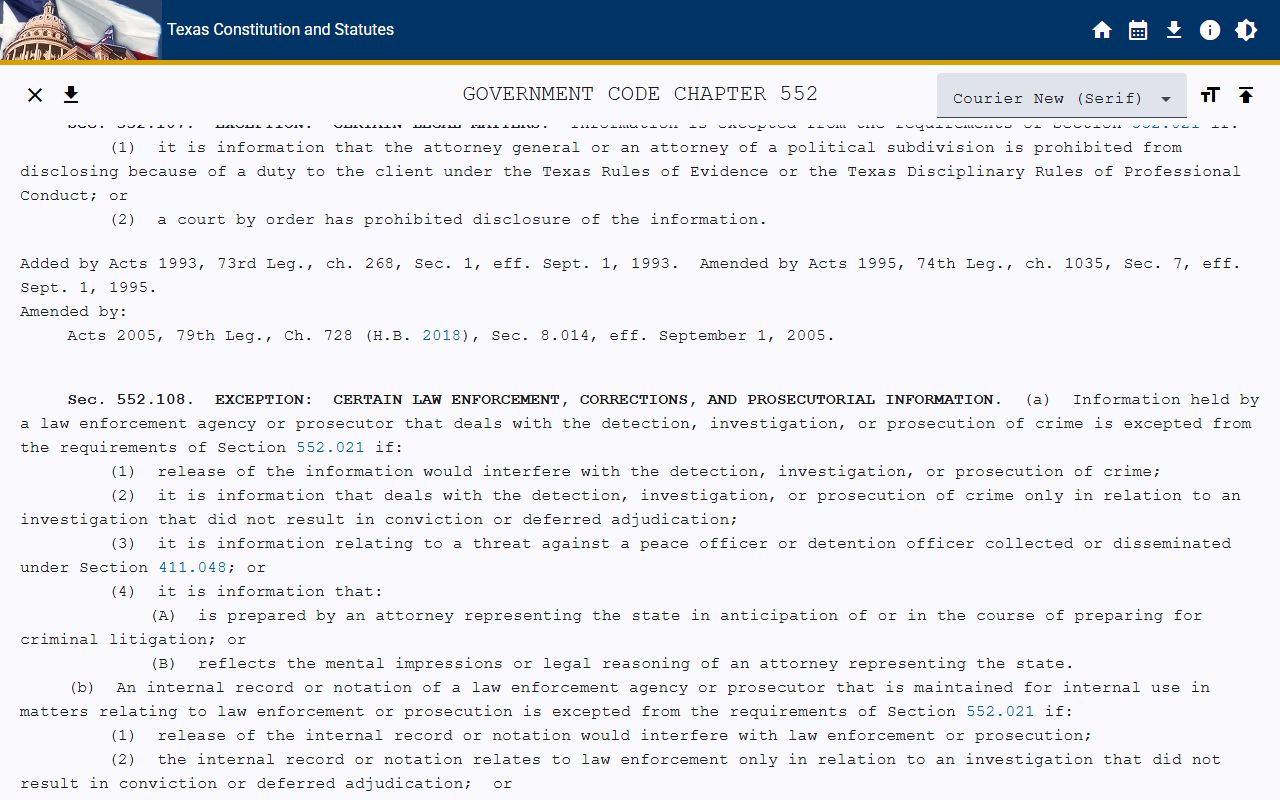
The screenshot below shows the Texas statutes site at Government Code Chapter 552, the public-information law that shapes what an agency may release about an open matter.
The law-enforcement exception in Government Code Section 552.108 lets agencies hold back information that would interfere with an active case.
With that in mind, the steps below help a person handle a warrant the right way.
- Do not rely only on third-party warrant lists.
- Search Tyler court records by name, case number, or citation.
- Search jail records to see current or recent custody.
- Contact the issuing clerk: District Clerk for felony, County Clerk for county court, or the JP court for lower cases.
- Ask whether bond is set and whether counsel can move to recall or quash.
- If arrest is likely, consult an attorney before any surrender.
- After it is resolved, confirm the docket and jail record no longer show an active hold.
Acting early almost always helps. A warrant that a person handles on their own terms, with counsel and a plan, is easier to resolve than one served during a routine traffic stop late at night.
After a Brazoria County Warrant Is Served
When a warrant is served, the case moves fast. The person is arrested and taken to the Brazoria County Detention Center for booking. A magistrate then reads the legal warnings and decides bond conditions under the rules of criminal procedure. From that point the matter runs as a court case, with settings, a charge, and a disposition. The warrant itself becomes one event in a longer record.
This is why a served warrant shows up in two places. The booking appears in the jail roster with a warrant number. The court case appears in Criminal Records with a docket. A person checking status should read both, since one can update before the other. The released inmates page covers what happens when custody ends.
The District Attorney and Brazoria County Warrants
Warrants do not stand alone. They sit beside the charging decision, which belongs to the prosecutor. Under Government Code Section 44.120, the Brazoria County Criminal District Attorney represents the State in criminal matters before the district and inferior courts in the county. So a felony charge that leads to a warrant runs through the District Attorney's Office, while the District Clerk's criminal staff issue the warrant and directives to the jail.
For a person with a possible warrant, this split matters. Questions about a charge or a plea go to the prosecutor and defense counsel. Questions about the warrant order and jail directive go to the clerk and the court. If you need court-appointed counsel, the county's Indigent Defense office handles those requests rather than the clerk.
Bench Warrants, Capias, and Bond Forfeiture
Several warrant terms come from missed dates and unpaid amounts. A bench warrant, often called a capias in Texas, comes from a court when a person misses an appearance or fails to follow an order. A capias pro fine is common in fine-only cases, where it brings a person before the court over unpaid fines or costs. A judgment nisi is a provisional bond-forfeiture ruling that follows a failure to appear after bond.
These entries can stack up in a docket. The sample criminal case showed a capias alias and a judgment nisi in its event list. A motion to revoke or adjudicate adds another layer when someone on probation or deferred adjudication is accused of a violation. Each one has its own way to clear, which is why the right court and, often, a lawyer matter.
Clearing a capias pro fine often means paying the fine and costs or appearing to set up a payment plan. Some courts allow a walk-in appearance to address the matter, while others require a bond first. The only way to know is to call the court named in the case. A jail booking that lists capias pro fine as the charge usually traces back to one of these fine-only matters rather than a new offense.
Restrictions on Warrant Information
Some warrant data is not public. A search warrant may be sealed while an investigation is open. Personal identifiers in a record, such as a driver license number, are protected and redacted. Motor vehicle record data is shielded by statute, which is why a warrant or jail entry may not show a full license number.
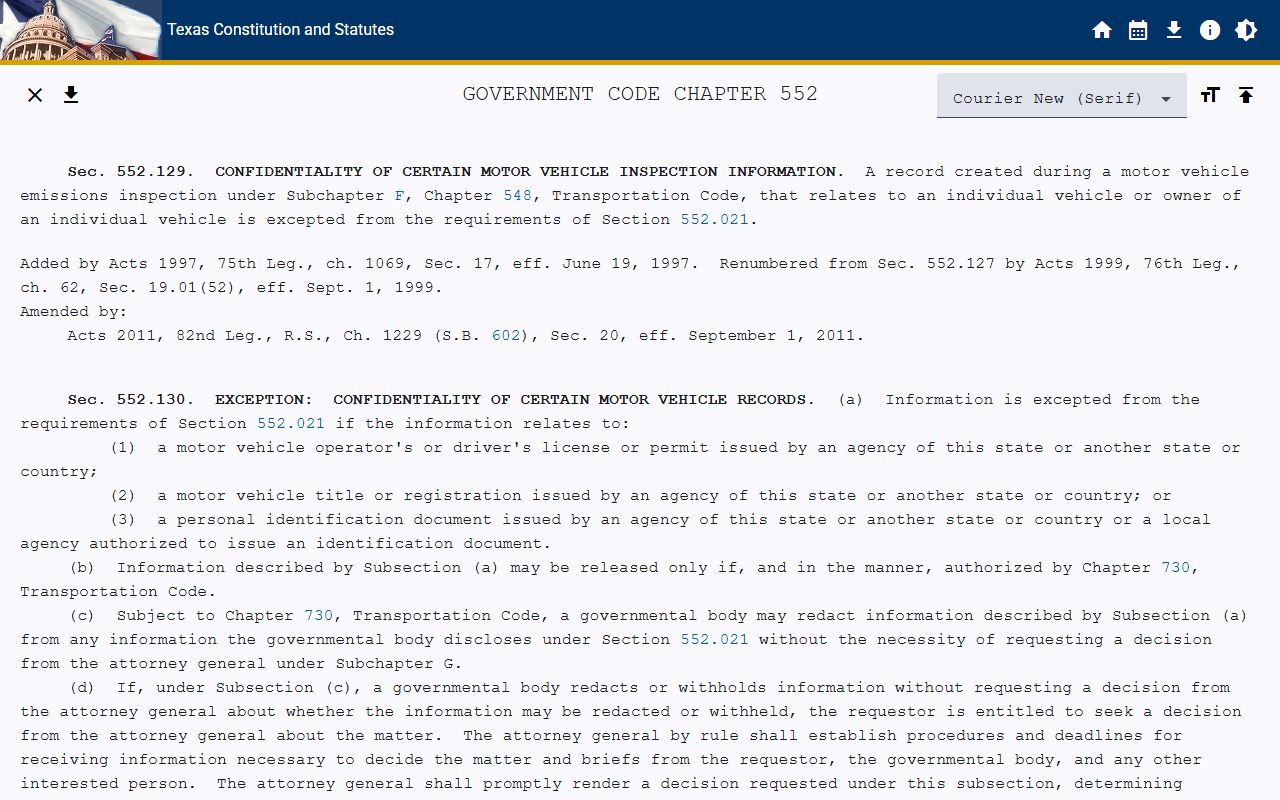
The image below shows the same statutes site at the section that protects that motor vehicle data.
The redaction rule comes from Government Code Section 552.130, which keeps driver license and vehicle identifiers out of public release.
Note: An empty warrant search is not proof that no warrant exists, since some warrants are sealed or simply not posted online.