
How to Search Brazoria County Probate Records
Probate records live with the County Clerk, who receives probate filings and keeps probate and civil county records. The county court portal also holds a Civil, Family and Probate Case Records search, which uses the same fields as the main court search. So you can look up a probate case online and then order copies from the County Clerk.
Start with the deceased person's name or the case number. The case-number asterisk rule applies in the portal. Probate cases can run for months or years, so use date filters to find the right matter when a name is common.
Probate often overlaps with property and family records, but it does not replace them. A will may pass a house, yet the deed that records that transfer is a separate County Clerk land record. A divorce may divide an estate's roots, yet it lives in the district court. So a full search sometimes means checking probate, real property, and court records together rather than just one.
- Open the Tyler PublicAccess portal and choose Civil, Family and Probate Case Records.
- Search by party name or by case number with an asterisk.
- Open the case to read the events and orders.
- Note the cause number and the probate court.
- Request a certified copy from the County Clerk.
Brazoria County Probate Courts
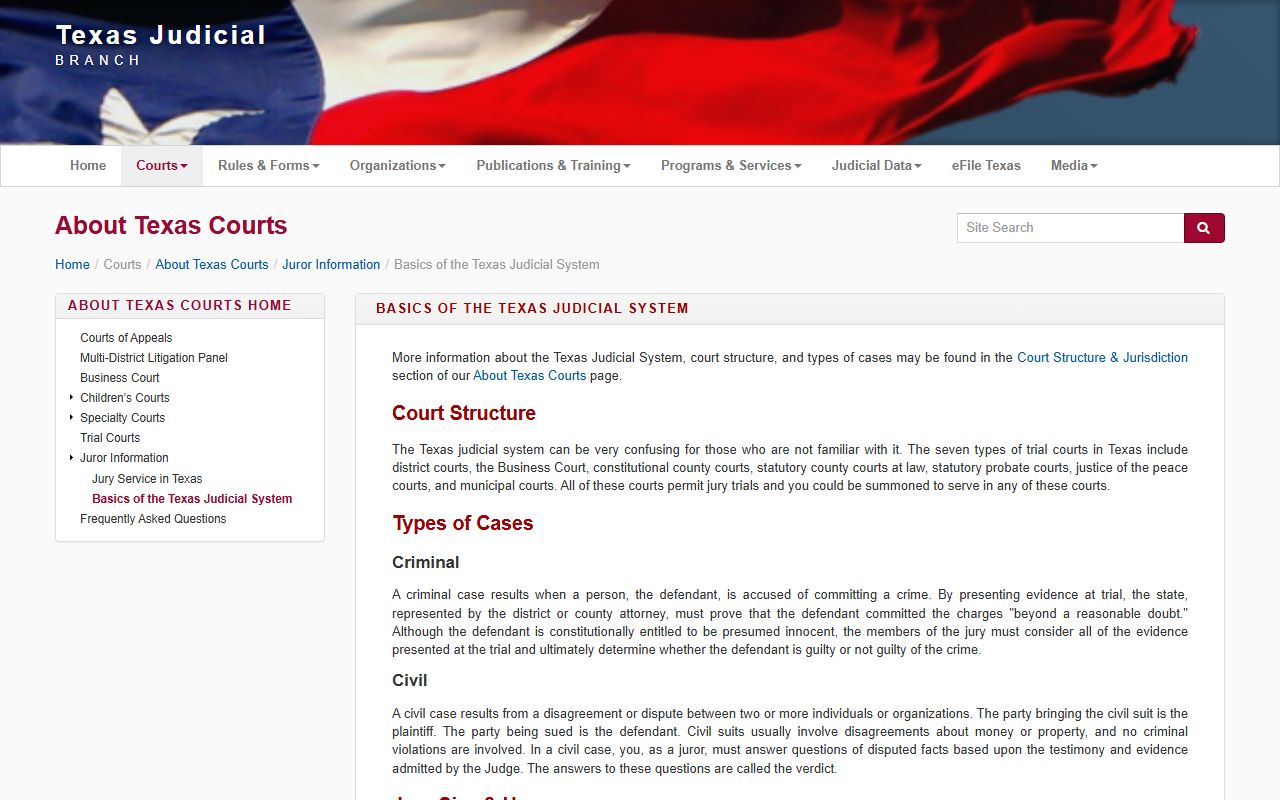
Texas spreads probate work across several court types. The Texas Judicial Branch lists statutory probate courts among the seven kinds of trial court in the state. In Brazoria County, the four county courts at law double as the probate courts, so the same judges who hear county civil and misdemeanor cases also hear wills, estates, and guardianships.
The screenshot below shows the Texas Judicial Branch page that explains this court structure.
The Texas Judicial Branch basics page lists statutory probate courts among the state's trial courts.
All four courts sit at the Brazoria County Courthouse in Angleton. The judges and direct lines are below.
County Court at Law No. 1 and Probate Court
Judge Courtney T. Gilbert
Brazoria County Courthouse, Angleton, TX 77515
979-864-1260
County Court at Law No. 2 and Probate Court
Judge Thomas Pfeiffer
Brazoria County Courthouse, Angleton, TX 77515
979-864-1571
County Court at Law No. 3 and Probate Court
Judge Jeremy E. Warren
Brazoria County Courthouse, Angleton, TX 77515
979-864-1603
County Court at Law No. 4 and Probate Court
Judge Lori Rickert
111 E. Locust, Room 201, Angleton, TX 77515
979-864-1980
What Brazoria County Probate Records Cover
Probate is broader than just a will. It covers how a court settles an estate, names someone to manage it, and protects people who cannot manage their own affairs. The records run from the first application through the final accounting.
- Applications to probate a will or to administer an estate.
- Inventories, appraisements, and lists of claims.
- Notices to creditors and heirship applications.
- Guardianship applications and investigator reports.
- Annual accounts, annual reports, orders, and final accountings.
Guardianship records can hold confidential medical, financial, and personal data, so some details may be restricted even when the case docket is public. The court records page explains the portal search that also reaches probate cases.
Wills, Estates, and Heirship
Most probate cases start with a death. When a person dies with a will, someone files to probate the will and to have the named executor appointed. When a person dies without a will, the estate is intestate, and the court follows the heirship rules to decide who inherits. Either way, the court oversees how debts are paid and how property passes to the right people.
The records show each step. An application to probate a will opens the case. An order admits the will and appoints the executor. Letters testamentary give that executor authority to act. For an intestate estate, an heirship proceeding and letters of administration do the same work. Inventories and lists of claims show what the estate holds and owes, and a final accounting closes the case. A Brazoria County probate search can trace this whole arc through the docket, from the first application to the final order that distributes the estate.
Common Brazoria County Probate Terms
Probate uses words that rarely come up elsewhere. A few definitions make a probate record far easier to read.
- Testator
- The person who made the will.
- Executor
- The person named in a will to carry it out.
- Intestate
- Dying without a valid will, which sends the estate to heirship rules.
- Administrator
- A person the court names to settle an estate when there is no executor.
- Guardianship
- A court arrangement that names someone to care for a person who cannot care for themselves.
- Conservator
- A person appointed to manage another's property or affairs, often used alongside guardianship.
How Probate Works in Brazoria County
A probate case follows a set path from filing to closing. The County Clerk takes the filing, the court is assigned, and the estate or guardianship is worked through to a final order. The steps below outline the local process.
- File the probate or guardianship application with the County Clerk.
- The case is assigned to one of the county courts at law and probate courts.
- Notice and service or publication occur as the law requires.
- For guardianship, the Probate Court Investigator reviews the case and files a report.
- The court holds a hearing on the will, the administrator, heirship, or the guardianship need.
- The clerk issues letters testamentary, of administration, or of guardianship if ordered.
- Inventories, annual reports and accounts, claims, and final accountings are filed with the County Clerk.
The clerk cannot give legal advice. For complex estates or contested guardianships, an attorney or the county Law Library can help a person find the right forms. Deadlines matter in probate, since creditors, heirs, and the court all work on a schedule, so a person handling an estate should track filing dates from the start and keep copies of every order the court signs.
The Guardianship Office and Probate Court Investigator
Guardianship has its own watchdog in Brazoria County. The Probate Court Investigation Office, also called the Guardianship Office, reports to all four probate courts. The investigator reviews the circumstances in a guardianship application to see whether a less restrictive alternative would work, then files a report. The office also audits annual accounts and reports and acts as a liaison between the probate courts and guardians.
The investigator's role protects vulnerable people. A guardianship can strip an adult of the right to make decisions, so the court wants proof that it is truly needed and that no lesser option will work. The investigator gathers that proof and reports to the judge, then keeps watch through annual audits after a guardian is appointed.
One rule is firm. All guardianship reports and accountings must be filed at the County Clerk's office only. The office contact is below.
Probate Court Investigator's Office
237 Locust Street, Suite 501
Angleton, TX 77515
979-864-1252
Brazoria County Probate Record Fees
Copy fees for probate records follow the County Clerk schedule, since the County Clerk keeps probate, plat, and official public records. The common copy fees are below. Filing fees for opening a probate case are separate and should be confirmed with the clerk.
| Item | Fee |
|---|---|
| Non-certified copy (per page) | $1.00 |
| Non-certified 11 x 17 copy | $2.00 |
| 24 x 36 plat or map copy | $5.00 |
| Certification fee (per document) plus page cost | $5.00 |
The County Clerk page covers the full copy process and office locations.
Public Access and Confidential Probate Information
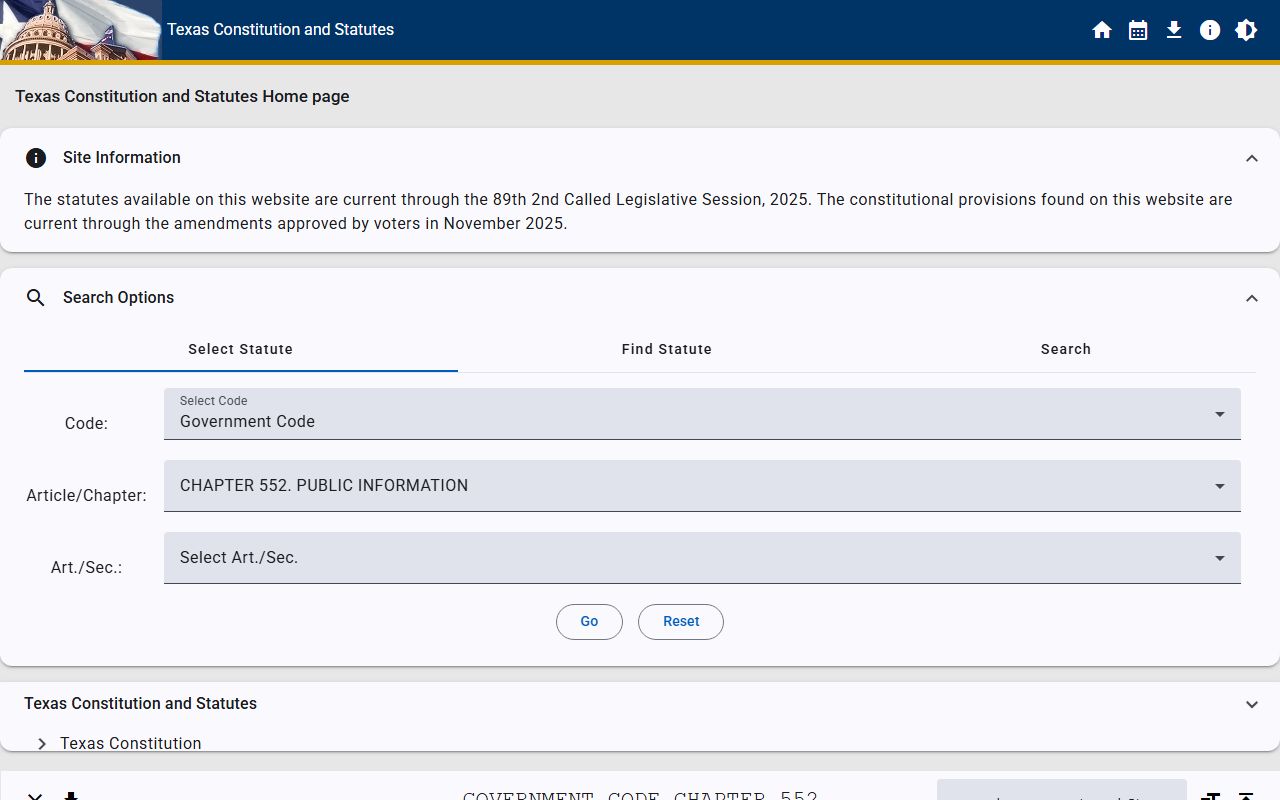
Most probate filings are public, but guardianship files can contain confidential medical and financial information. Texas treats government records as open under the Public Information Act, while courts protect sensitive personal data. So a probate case can be public while a medical report inside a guardianship is restricted.
The screenshot below shows the Texas statutes site at Government Code Chapter 552, the public-information law.
The Texas Public Information Act sets the open-records baseline that shapes access to county records.
When a probate record is sensitive, the County Clerk can explain whether a redacted copy is available or whether a court order is needed to view it. A certified copy of an order, a will, or letters testamentary is the version a bank, a title company, or another court will accept, so request certification when the copy is for official use rather than personal reference.