
How to Search Brazoria County Traffic Court Records
Start with the citation itself. The court named on the ticket is the court that holds the record. Many county justice court citations appear in the Tyler PublicAccess portal, which has a citation search option and lists two justice courts, JP4-1 and JP2-1, in its location picker. A municipal citation, written inside a city, usually goes to that city's own court and payment page instead.
You can search by citation number, by defendant name, or by case number. The case-number asterisk rule applies. If a citation is brand new, it may not appear online yet, since the court has to file it first. When the portal comes up empty, the court named on the ticket is the place to call.
- Read the citation and find the court that issued it.
- Open the portal and set the location to all courts or a JP court.
- Choose to search by citation, defendant, or case number.
- Enter the citation or name, adding an asterisk to a case number.
- If nothing shows, contact the court named on the ticket.
Which Courts Handle Traffic Cases in Brazoria County
Traffic cases split across court types by where the stop happened and how serious the charge is. County justice of the peace courts handle citations filed in their precincts, including stops by deputies, constables, and state troopers. City municipal courts handle citations written inside city limits, in places like Angleton, Alvin, Pearland, Lake Jackson, Freeport, Clute, Manvel, and West Columbia.
Serious traffic conduct is different. When driving becomes a crime, such as driving while intoxicated, driving while license invalid, or evading arrest, the case is a misdemeanor or felony that runs through the county or district courts, not a fine-only ticket. Those route to the arrest records and court records systems rather than a JP traffic docket.
Types of Traffic Cases on Record
Traffic records cover a wide range, from a simple speeding ticket to a serious driving crime. Most are Class C, fine-only matters in a justice or municipal court. A smaller share are criminal cases. The list below shows the common types.
- Speeding and other moving violations.
- No insurance, expired registration, and equipment violations.
- Driving while license invalid, which can be criminal.
- Driving while intoxicated, a criminal charge.
- Evading arrest and other driving-related crimes.
- Failure to appear or pay, which can add a capias.
A fine-only ticket and a criminal driving charge are handled very differently, so it helps to know which one a record shows before acting on it.
What Brazoria County Traffic Court Records Show
A traffic court record captures the citation and how the case was resolved. It is the court's file, not the state's driver history. The fields below are the ones a traffic record usually holds.
- Citation number and defendant name.
- Charge or offense, and the statute or ordinance.
- Law-enforcement agency and the date, time, and place of the offense.
- Court or precinct and the appearance date.
- Plea, fine, and court costs.
- Defensive driving or deferred disposition status.
- Dismissal, conviction, or a capias for failure to appear.
A driver license number may be collected, but it should not be shown in full in a public record. The court file also notes whether the disposition was reported to the state.
Searching by Citation Number vs by Name
The portal offers more than one way to find a traffic case, and the best choice depends on what you have. A citation number is the most exact. A name search is broader and useful when the ticket is lost. The table below lists the search fields for the county citation lookup.
| Field Label | Type | Required | Notes / Format |
|---|---|---|---|
| Location | Dropdown | Important | All Courts, JP4-1, or JP2-1 |
| Search By | Dropdown | Yes | Case, Defendant, Citation, or Attorney |
| Citation Number | Text | For citation search | Use the number from the ticket |
| Case Number | Text | For case search | Add an asterisk at the end |
| Last Name / First Name | Text | For name search | Defendant name fields |
| Date Filed Range | Date | No | On or after / on or before |
A citation search jumps straight to the case. A name search may return several rows, so add a date range to narrow it.
Paying or Contesting a Brazoria County Traffic Ticket
How you handle a ticket depends on the court named on it and the choice you make. Paying a ticket can count as a plea and a conviction, while contesting it keeps the case open. The county justice court pages post payment information, defensive driving rules, ticket dismissal information, and class links. The published fine schedule even warns drivers to contact the court to verify the amount, since costs can vary.
- Read the citation and find the court named on it.
- Use that court's page for payment, dismissal, or class options.
- Verify the exact amount with the court before paying.
- To request defensive driving, ask the court first; do not take the course early.
- To plead not guilty, contact the court by the deadline and request a setting.
- Keep proof of payment, course completion, and any court order.
The official ticket reply form lets a driver enter a plea of no contest and request defensive driving for dismissal. Because each court can use different forms and standing orders, the court on the citation is the one that controls.
Public Access Laws for Traffic Court Records
Adult traffic court cases are generally public, like other court records. Texas treats government records as open by default, while court files follow court rules. So a person can usually look up an adult traffic case and read its disposition.
Privacy rules still apply. Driver license numbers and personal identifiers are protected under Government Code Section 552.130 and other laws, so a public record should not show a full license number. Juvenile traffic matters carry extra confidentiality. The public records page covers the broader access framework.
Court Traffic Records vs State Driver Records
These are two different files, and confusing them causes real problems. A court traffic record is the case file held by the court. A state driver record is held by the Texas Department of Public Safety and shows a person's license history. Resolving a court case does not always update the driver record at once.
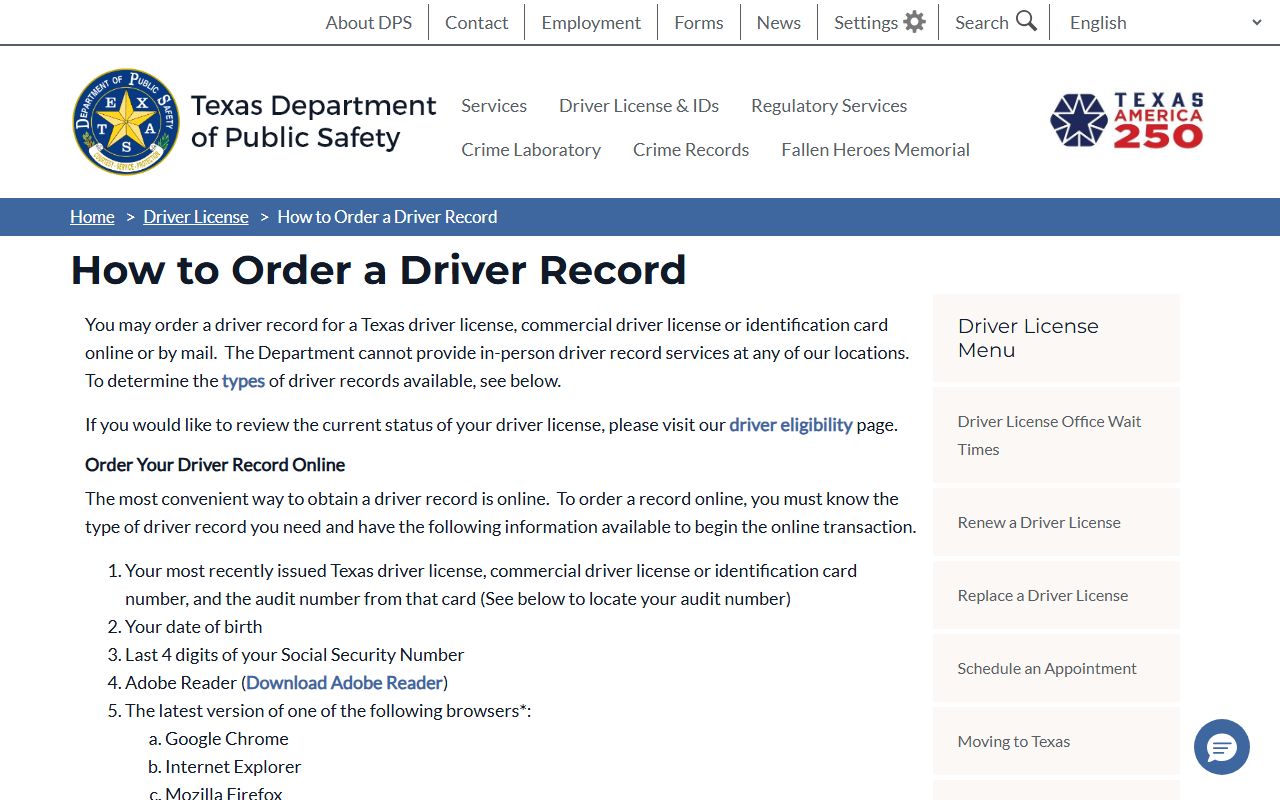
The screenshot below shows the DPS page for ordering a driver record.
The Texas DPS driver record page explains how to order a state driver record.
| Point | Court Traffic Record | State Driver Record |
|---|---|---|
| Kept by | JP, municipal, or county court | Texas DPS |
| Shows | Citation, plea, fine, disposition | License status, crashes, violations, suspensions |
| Used for | Pay or contest a ticket, prove disposition | Insurance, employers, license status |
| How to get it | Court clerk | DPS online or by mail |
Ordering a Texas Driver Record
DPS offers several driver record types at different prices, and only one type works for a defensive driving course. The record is ordered online or by mail, not in person at a DPS office. The fee schedule is below.
| DPS Record Type | Fee | Contents |
|---|---|---|
| Type 1 status record | $4.00 | License status and basic info |
| Type 2 three-year history | $6.00 | Moving violations and crashes, three years |
| Type 2A certified three-year | $10.00 | Certified; not valid for defensive driving |
| Type 3 all crashes and violations | $7.00 | Full record to the subject only |
| Type 3A certified full record | $10.00 | The only type valid for defensive driving |
| Type AR certified abstract | $20.00 | Type 3 plus all suspensions |
The screenshot below shows the DPS driver record FAQ, which explains the record types and ordering rules.
The DPS driver record FAQ answers common questions about ordering and using a driver record.
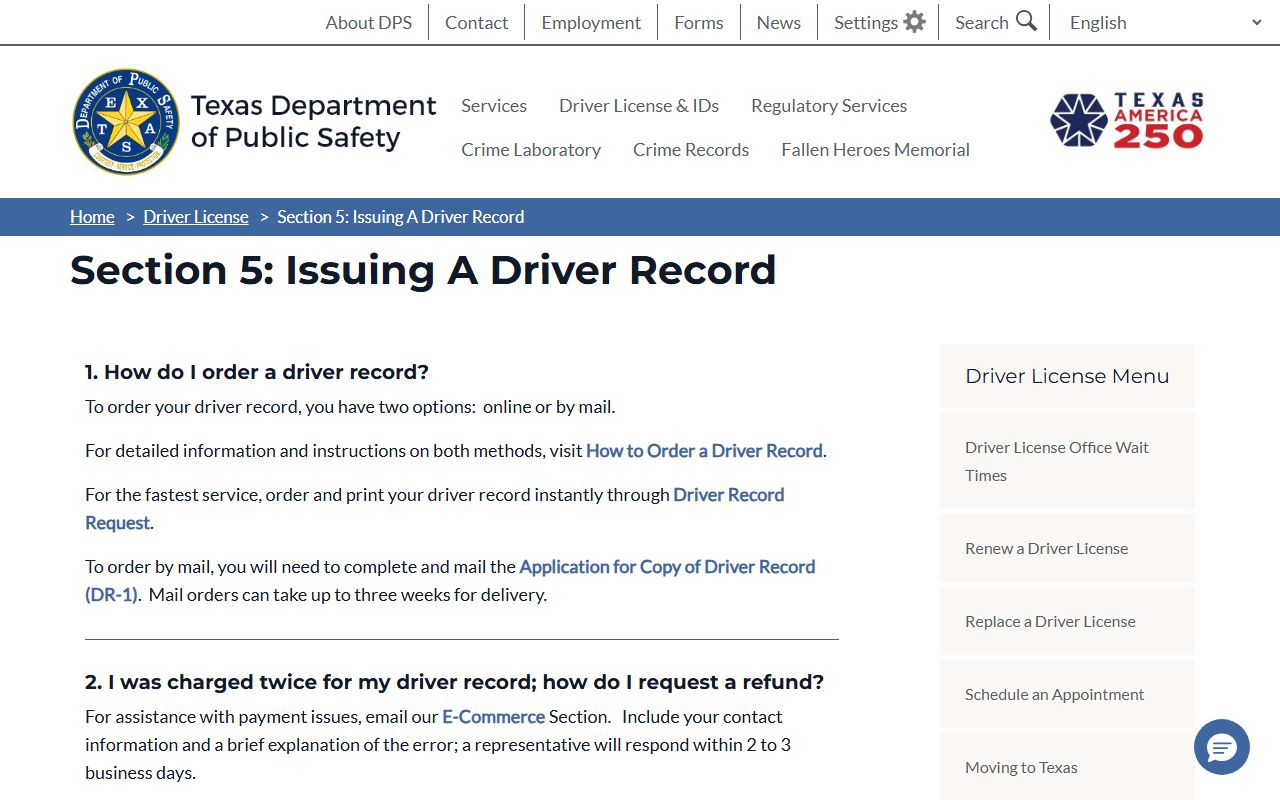
To order, a requester needs the most recent Texas license or ID number, the audit number from that card, date of birth, the last four digits of a Social Security number, and a credit card.
CDL and Commercial Driver Records
Commercial drivers face stricter rules. A Brazoria County justice court form for deferred disposition states that if a driver holds a commercial driver license, or held one at the time of the offense, deferred disposition for a traffic offense will not be granted. So a CDL holder cannot assume the same options as a regular driver.
The stakes are higher because a commercial record affects a person's job. A CDL holder should call the court named on the citation and consider legal advice before paying, requesting deferral, or taking a driving course. What looks like a small ticket can carry large consequences for a commercial license.
DUI and DWI Cases
Driving while intoxicated is not a fine-only traffic ticket. It is a criminal charge that runs through the county or district courts, not a JP traffic docket. A DWI case generates a criminal record, can involve a booking at the jail, and may carry license consequences on top of the court case.
Because a DWI is criminal, its record is searched like any other criminal case. The arrest records page covers booking and charge data, and the court records page covers the full case file and disposition.
Deferred Disposition and Defensive Driving
Texas offers a couple of ways to keep a ticket off a record, but each has rules. Deferred disposition holds the case open for a set period, and the charge can be dismissed if the driver stays out of trouble. A defensive driving course can also lead to dismissal, but the driver must usually ask the court first and provide the right driver record.
A Brazoria County justice court spells out the local steps for a mailed deferred-disposition request. The driver must call the court first for the costs, the deferral fine, and confirmation that the charge qualifies, then send a signed statement with a no-CDL statement and the requested deferral period, which can be one day, two weeks, one month, or 90 days. For defensive driving, DPS says the Type 3A certified record is the one used for the course. Do not take the course before the court approves it.
Sealing or Expunging Traffic Records
Most fine-only traffic cases are minor, but a person may still want an old record cleared, especially a criminal driving charge. Texas allows expunction in some cases under Code of Criminal Procedure Chapter 55, and an order of nondisclosure can seal an eligible record. Eligibility is technical and turns on how the case ended.
A dismissed or deferred charge may open the door to relief, while a conviction usually does not. Juvenile traffic matters carry extra confidentiality. The arrest records page covers expunction and nondisclosure in more depth, including which agencies must be named in a petition.
Fees for Traffic Records and Crash Reports
Copy costs depend on the record. A court traffic record copy comes from the court clerk. A state driver record comes from DPS at the prices listed above. A crash report is yet another document, held by the state rather than the court.
The screenshot below shows the TxDOT crash reports and records page.
The TxDOT crash reports page explains how to buy a Texas Peace Officer's Crash Report.
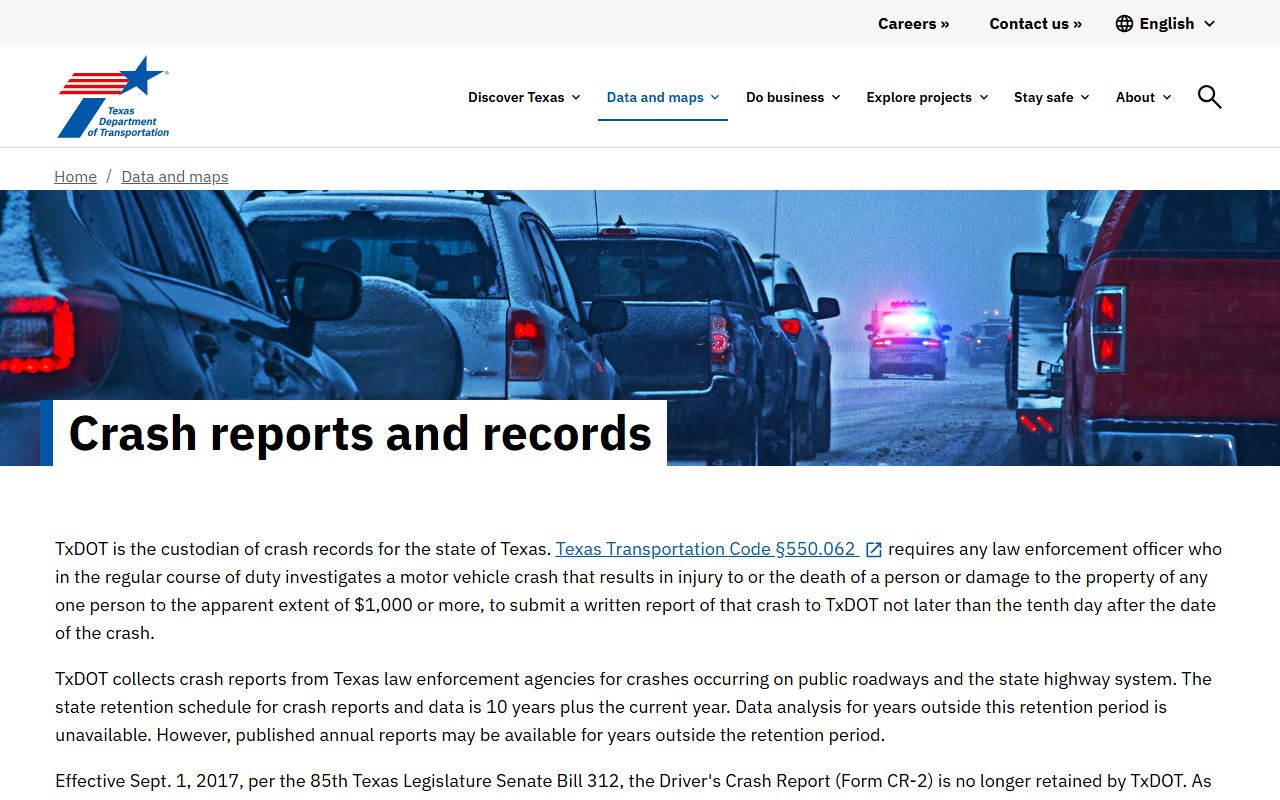
TxDOT sells the crash report through its online purchase system, with a certified copy priced at $8. A crash report is separate from both the court traffic record and the DPS driver record, so a single wreck can create three different files in three different systems.