
How to Search Brazoria County Marriage and Divorce Records
The split between the clerks shapes every search. The County Clerk handles marriage licenses, marriage copies, and many official public records. The District Clerk handles divorce, since divorce is a family case filed in district court. So a full marital history can touch both offices.
For a marriage record, use the County Clerk's marriage services or visit a County Clerk office. For a divorce, search Civil, Family and Probate Case Records on the Tyler PublicAccess portal, then request a certified copy from the District Clerk. Family files can have public docket entries while sensitive pleadings stay restricted.
- Decide whether you need a marriage record or a divorce record.
- For marriage, go to the County Clerk's marriage services.
- For divorce, open the portal and search Civil, Family and Probate Case Records.
- Note the case or cause number and the court.
- Request a certified copy from the proper clerk.
Brazoria County Marriage License Fees
The County Clerk sets the marriage fees, and they vary by license type. A premarital education course lowers the cost, and the county recognizes informal marriage. The current amounts from the County Clerk fee page are below. Confirm them with the office, since fees can change.
| Marriage Item | Fee |
|---|---|
| Marriage License | $81.00 |
| Marriage License with Twogether in Texas | $21.00 |
| Informal Marriage License | $46.00 |
| Duplicate License | $30.00 |
| Marriage Search Fee (Brazoria County only) | $20.00 |
The Twogether in Texas program is a premarital education course. Finishing it drops the license fee sharply, from $81.00 to $21.00, which is a real saving for couples who plan ahead. Couples who choose this path should finish the course first, then bring proof when they apply, so the County Clerk can apply the reduced fee at the counter.
How to Apply for a Brazoria County Marriage License
A marriage license comes from the County Clerk. The county offers an online service to apply for a license and to request copies, and the online application link goes to a TylerHost portal. Most couples either complete the county's online pre-application or appear at a County Clerk office to finish the process.
- Start the application through the County Clerk's marriage service or in person.
- Bring valid government photo ID for both applicants.
- Pay the license fee, or the reduced fee with Twogether in Texas.
- Observe the 72-hour waiting period after the license is issued.
- Hold the ceremony within 90 days, before the license expires.
Officiants in Texas include licensed or ordained ministers, certain religious officers, and judges, among others authorized by the Family Code. The 72-hour wait can be waived in limited cases set by law.
Brazoria County Marriage License Requirements
Texas sets the basic rules, and the County Clerk applies them. The online application link exits to TylerHost, and the exact online form fields were not available during research, so confirm the current field list with the County Clerk. The core requirements, though, are well settled.
- Valid government photo ID for each applicant.
- Both applicants involved in the application as required.
- Payment of the license fee, reduced with Twogether in Texas.
- A 72-hour wait after issuance, unless waived or excepted.
- A ceremony within 90 days, or the license expires.
The County Clerk also redacts Social Security numbers from marriage applications, since that data is protected. The County Clerk page covers the office locations and hours where you can apply.
Informal and Common-Law Marriage
Texas recognizes informal marriage, often called common-law marriage. The County Clerk issues an informal marriage license for a lower fee than a formal one. An informal marriage forms when a couple agrees to be married, lives together in Texas as spouses, and represents to others that they are married. A Declaration of Informal Marriage recorded with the County Clerk creates a public record of that union.
The record matters later. Couples sometimes need to prove an informal marriage for benefits, inheritance, or a divorce. Because the informal marriage license and declaration are County Clerk records, a search for that proof runs through the County Clerk, not the district court. A later divorce of an informally married couple still goes to the District Clerk like any other divorce.
Brazoria County Divorce Records
Divorce is a district court matter, so the District Clerk is the custodian for divorce files. The District Clerk holds civil, family, and felony criminal court records. Divorce files can be searched through the Civil, Family and Probate Case Records branch of the county portal, and certified copies are ordered from the District Clerk's records process.
Family files carry sensitive data. Minor names, financial identifiers, and some family-violence details may be redacted or restricted, even when the case docket is public. So a divorce search may show the case and its events while keeping certain documents off the public view. The court records page explains the portal search in more detail.
A divorce file can hold many documents. It may include the original petition, the answer, temporary orders, custody and support orders, a property division, and the final decree. The portal often shows the docket of these events, with the case style and the assigned court. To prove the divorce or a name change, the final decree is the key document, and a certified copy of it comes from the District Clerk. For a full marital history, note the spouse names as recorded, the cause number, the filing date, the court, and the disposition date.
How to File for Divorce in Brazoria County
A divorce starts with residency and ends with a signed decree. Texas sets a residency rule and a waiting period, and the District Clerk receives the filing. The steps below outline the path. They are general guidance, not legal advice, since each case differs.
- Confirm residency: one spouse generally lives in Texas six months and in the county 90 days before filing.
- Prepare the petition for divorce and any required forms.
- File with the District Clerk in Brazoria County.
- Pay the filing fee, or file a statement of inability to afford costs.
- Serve the other spouse, unless a waiver or answer is filed.
- Observe the waiting period, generally at least 60 days before the divorce is final.
- Resolve property, debt, custody, support, and any name change.
- Present the final decree to the judge for signature.
The clerk cannot give legal advice. For help, the county Law Library and self-help resources, plus statewide guides, can point a self-represented spouse to the right forms.
Certified Copies of Marriage and Divorce Records
A certified copy is the version courts and agencies accept. For a marriage record, the County Clerk provides certified copies and runs a Brazoria County marriage search for a set fee. For a divorce decree, the District Clerk provides certified copies through its records process, which can be done in person, by mail, or by email after online payment.
Match the record to the right office. A marriage-copy request goes to the County Clerk. A divorce-decree request goes to the District Clerk. The District Clerk and County Clerk pages list the copy steps and fees for each.
Plan for the type of copy you need. A plain copy is fine for personal reference, but a certified copy is what a court, a bank, or an agency usually requires for an official use such as a name change or a benefits claim. Bring or include the case or cause number, the names as recorded, and the document title so the clerk can find the right record quickly. For a mailed request, the District Clerk accepts a cashier's check or money order with the copy request form.
Public Access and Confidential Family Information
Marriage and divorce records are generally public, but family files include protected data. Texas treats most government records as open under the Public Information Act, while court files follow court rules. Personal identifiers, minor information, and some family-violence details are kept out of public view.
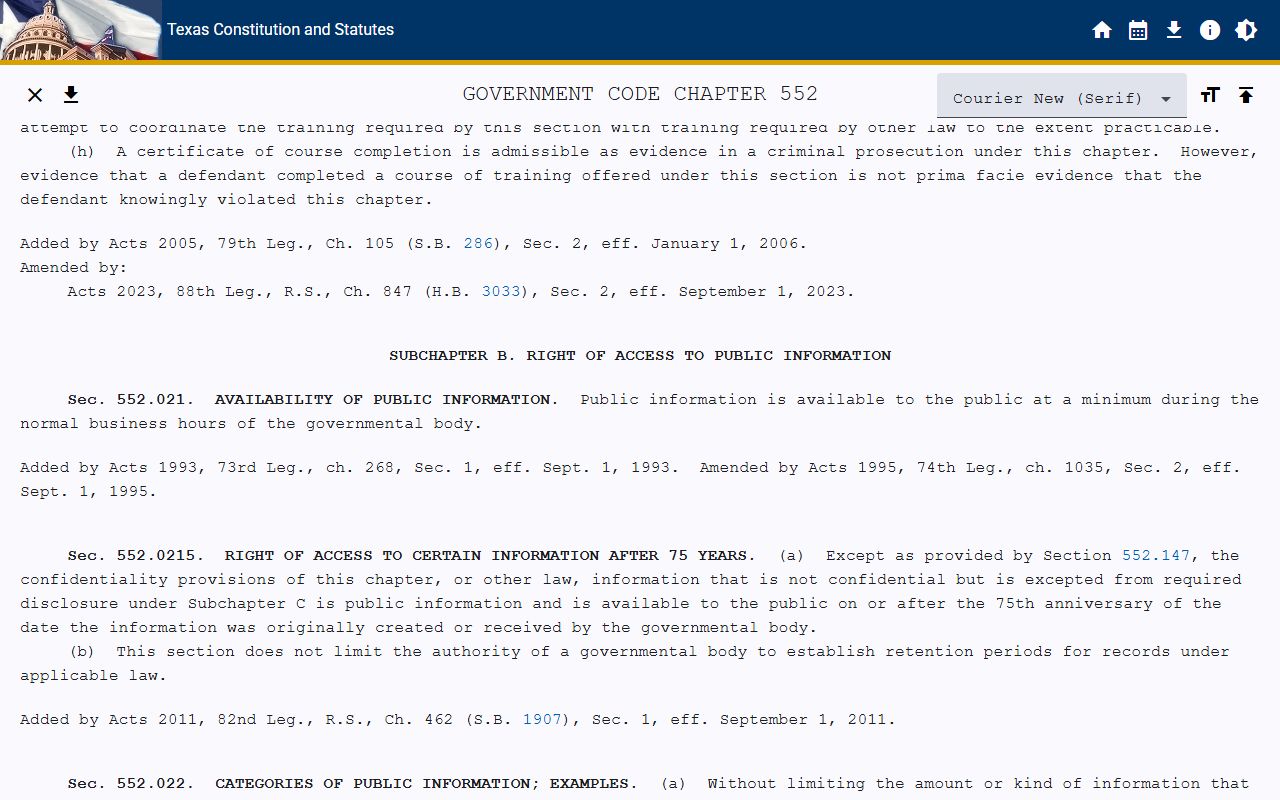
The screenshot below shows the Texas statutes site at Government Code Chapter 552, the public-information law.
The availability rule in Government Code Section 552.021 sets the baseline that public records are open for inspection.
So a divorce docket may be public while a financial affidavit inside it is not. When a record is restricted, the clerk can explain whether a redacted copy is available or whether a court order is needed.